Soak Leftover Lemon Halves in White Vinegar for a Powerful Natural Cleaner
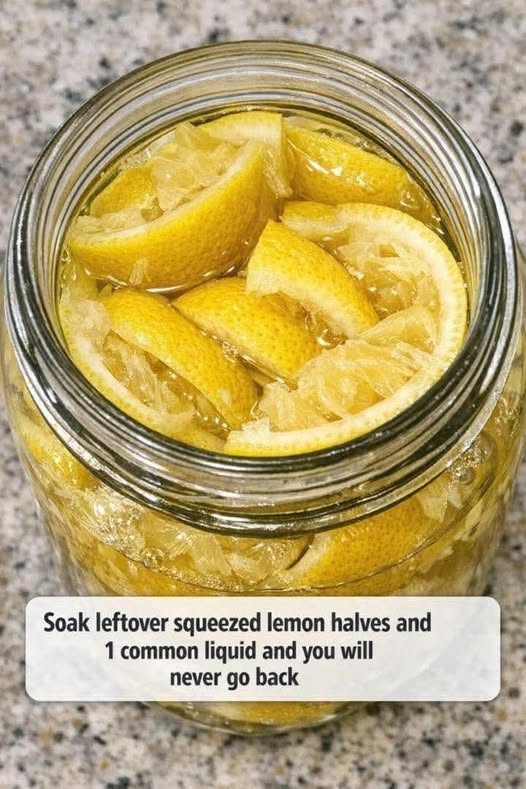
Most households produce leftover squeezed lemon halves regularly — citrus squeezed for cooking, for drinks, for salad dressings — and most of those halves go directly into the compost or trash with their remaining value completely unused. A squeezed lemon half still contains significant citric acid in its peel and pith, still holds the aromatic essential oils that give lemon its characteristic fresh scent, and still has the mild abrasive texture of the peel’s exterior. All of these properties are useful for cleaning. When the squeezed halves are submerged in white vinegar and left to infuse for 24 hours to a week, they produce a citrus-infused vinegar cleaning solution that outperforms either ingredient alone on hard water deposits, mineral buildup, soap scum, and general household grime — and does it with a fresh citrus scent rather than the sharp, clinical smell of plain vinegar.
This preparation costs essentially nothing, since it uses ingredients that would otherwise be discarded (the lemon halves) and one of the least expensive cleaning liquids available (white vinegar at approximately two to three dollars per gallon). It produces a multi-surface cleaning spray that is genuinely effective on the household surfaces where hard water deposits and mineral buildup accumulate — bathroom faucets, showerheads, glass shower doors, kitchen sinks, stainless steel — and safe enough to use without protective equipment beyond basic gloves.
Why This Combination Works
Hard water stains — the white, cloudy, or chalky deposits that form on faucets, showerheads, and glass surfaces in areas with mineral-rich tap water — are primarily calcium carbonate and magnesium carbonate, both of which are alkaline mineral salts. Acidic solutions dissolve these salts through a straightforward chemical reaction: the acid’s hydrogen ions react with the carbonate compound, breaking it apart and releasing it from the surface as soluble ions that can be wiped or rinsed away.
Both white vinegar (which contains acetic acid) and lemon juice (which contains citric acid) are effective against hard water deposits through this mechanism. The combination of the two acids in a single solution produces a broader-spectrum cleaning agent — acetic acid and citric acid have somewhat different solubility profiles for different mineral compounds, and the combination addresses a wider range of deposit types than either alone. The infusion process, during which the lemon halves steep in the vinegar for one to seven days, also extracts the essential oils and additional citric acid from the lemon peel, producing a more aromatic, more acidic solution than plain vinegar at the same pH.
The lemon peel’s texture adds a third cleaning mechanism when the soaked halves are used as scrubbers directly: the slightly abrasive, waxy surface of the peel provides physical scrubbing action alongside the chemical dissolution, making it effective on surfaces with heavy deposit buildup that chemical action alone would take longer to address.
How to Make the Infused Cleaning Solution
The preparation requires only a clean glass jar, leftover squeezed lemon halves, and white vinegar. Any size jar works — a quart mason jar is the most practical size for a household that produces lemon halves regularly, as it holds enough vinegar for a useful quantity of finished solution and accommodates three to four lemon halves comfortably.
Place the squeezed lemon halves in the jar, cut side down. Pour white vinegar over them until they are completely submerged — the lemon halves tend to float, so weight them down with a small glass or ceramic object if needed, or simply push them under the vinegar surface with a spoon each time you open the jar. Seal the jar and place it in a cool, dark location (a cupboard under the kitchen sink is convenient) for a minimum of 24 hours. For a more potent solution with more fully extracted lemon oil and citric acid, allow the infusion to continue for up to seven days before straining and using.
After the infusion period, strain the liquid through a fine mesh strainer or cheesecloth into a clean spray bottle. The strained solution is the finished cleaner — transfer the lemon halves to the compost. Label the spray bottle clearly and store it under the sink or in a cleaning supply area. The solution keeps indefinitely at room temperature; vinegar’s acidity prevents spoilage.
What You Need
- Leftover squeezed lemon halves (3 to 6, accumulated over any period)
- White distilled vinegar, enough to fully submerge the lemon halves
- A clean glass jar with a lid (quart size or larger)
- A fine mesh strainer or cheesecloth
- A spray bottle for the finished solution
How to Use It
see continuation on next page
