BUTTERY CROISSANT-STYLE SOURDOUGH LOAF
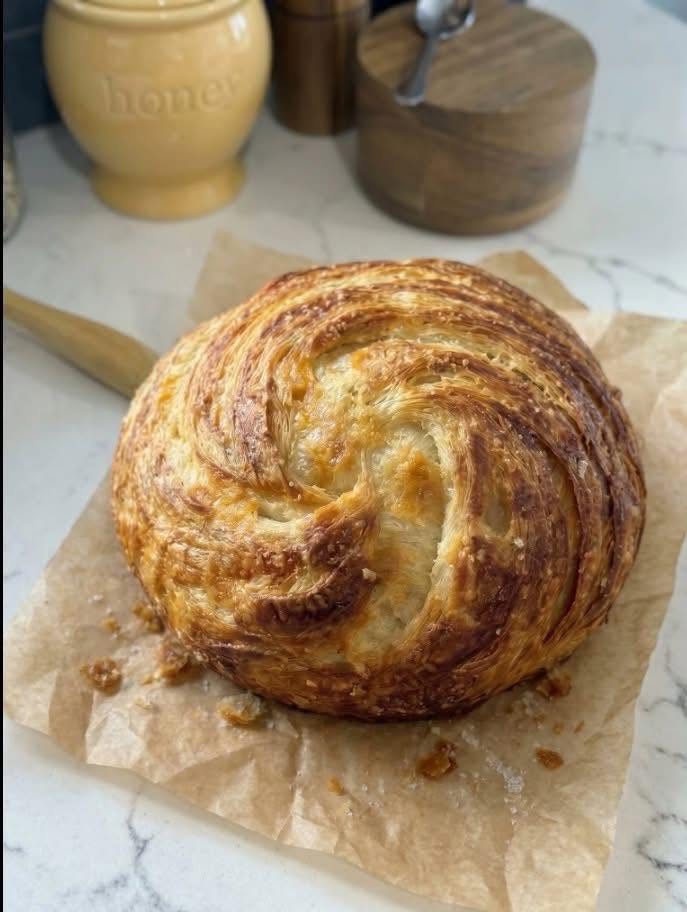
Step-by-Step Instructions
Day 1 (Evening) – Make the Levain
- Mix the starter, 35g flour, and 35g water in a small jar.
- Cover loosely and let sit at warm room temperature (70-75°F/21-24°C) for 8-12 hours. It should be bubbly, domed, and smell pleasantly sour.
Day 2 (Morning) – Make the Dough
- Mix the Dough
· In a large bowl, combine the levain, bread flour, sugar, salt, warm milk, egg, and 40g of very soft butter.
· Mix with a dough whisk or spatula until a shaggy mass forms. It will be sticky – that’s fine.
- Knead (Short & Sweet)
· Knead by hand for 8-10 minutes or with a stand mixer (dough hook) on medium for 6 minutes, until the dough is smooth, elastic, and clears the sides of the bowl. It should be soft and slightly tacky but not a sticky mess.
· Tip: Wet your hands slightly to reduce sticking.
- First Fermentation (Bulk Ferment)
· Place the dough in a lightly oiled bowl. Cover and let rise at room temperature for 4-5 hours, performing 3 sets of stretch-and-folds every 45 minutes for the first 2.5 hours. This builds strength.
· The dough should become puffy and nearly double.
- Prepare the Butter Spread
· In a small bowl, mix the 85g very soft butter with 15g flour until completely smooth. It should be spreadable like cream cheese.
· Set aside at room temperature.
- The “Fake Lamination” (Rolling & Folding)
· Lightly flour your work surface.
· Roll the dough into a 12×16 inch rectangle (about ½ cm thick).
· Using an offset spatula or knife, spread the butter mixture evenly over the entire surface of the dough, leaving a ½-inch bare border on one long edge.
· Fold like a business letter: Fold the top third down over the middle, then the bottom third up over that. You now have a 4×16 inch strip.
· Roll out again into a 8×16 inch rectangle.
· Fold again (same letter fold). You now have a tight, butter-layered packet.
· Wrap in plastic and refrigerate for 30 minutes (this relaxes the gluten and chills the butter slightly, but not fully).
- Shape into a Loaf
· On a lightly floured surface, roll the chilled dough into a 8×12 inch rectangle (about ½ inch thick).
· Starting from the short end (8-inch side), roll it up tightly like a cinnamon roll into a log.
· Pinch the seam to seal.
· Place the log seam-side down into a greased 9×5 inch loaf pan.
- Second Fermentation (Final Proof)
· Cover the pan loosely with plastic wrap or a damp towel.
· Let rise at room temperature for 3-5 hours, until the dough has puffed up to just below the rim of the pan (about 75% of the way up). It should feel pillowy and hold a gentle indentation when poked.
· Option: Retard (slow proof) in the refrigerator overnight for deeper sourdough flavor. If so, let it sit at room temp for 2 hours before baking.
- Bake to Golden, Buttery Perfection
· Preheat oven to 375°F (190°C).
· Brush the top generously with egg wash.
· (Optional) Sprinkle with flaky sea salt.
· Bake for 35-40 minutes.
· At 20 minutes: Rotate the pan for even browning. If the top is browning too fast, tent loosely with foil.
· The loaf is done when:
· Internal temperature reaches 200°F (93°C).
· The top is deep golden brown.
· It sounds hollow when tapped on the bottom.
- Cool (The Hardest Part)
· Let the loaf rest in the pan for 5 minutes, then turn out onto a wire rack.
· Cool completely for at least 1 hour before slicing. This allows the buttery layers to set – if you slice hot, it will crumble and seem “doughy.”
What to Expect: Texture & Taste
see continuation on next page
